The Audit Assistant – AI’s Role in Compliance and Fraud Detection in Medical Clinics
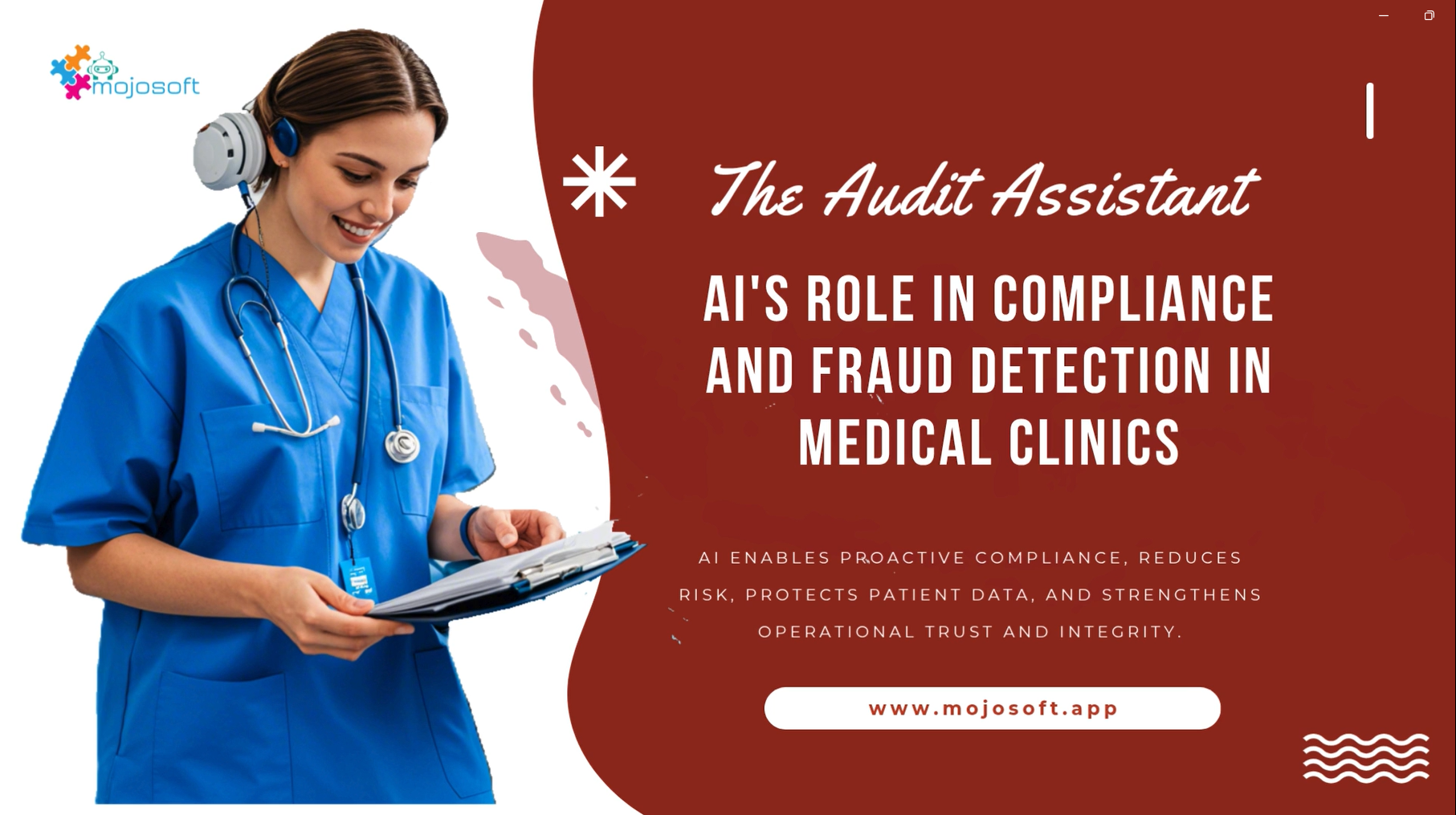
 The Audit Assistant:
How AI Is Quietly Becoming the Most Important Compliance Officer in Medical Clinics
Across Singapore and the region, medical clinics today live in a landscape where compliance is unforgiving and fraud risks are evolving faster than traditional controls can keep up.
Directors, owners, and administrators are held accountable for strict obligations:
 PDPA & patient data privacy
MOH governance and subsidy compliance
Payer rules from government schemes & private insurers
Transparent billing, inventory, and clinical documentation
Yet despite everyone’s best effort, most clinics still rely on processes built for a different era—manual checks, sampling audits, and after-the-fact investigations.
Meanwhile, healthcare fraud, waste, and abuse (FWA) has become more subtle, more digital, and more expensive. Not the Hollywood version of “multimillion-dollar scams”—but quiet leakage: unnecessary billing codes, repeated high-cost claims, suppliers linked to staff, inappropriate EMR access… all small, all invisible to traditional auditing… until too late.
The uncomfortable truth:
Traditional audit processes were never designed for the speed, data volume, and sophistication of today’s healthcare environment.
And that is exactly why management teams are turning to AI.
 Why Traditional Compliance Is Failing Leaders
1. Audits only see the past
Most non-compliance is discovered months after damage is done. Funds lost, records outdated, employees gone, and no clean way to recover.
2. Fraud hides in small anomalies
A single missed entry.
A slightly inflated claim.
An oddly frequent treatment.
Manually spot-checking 2% of records will never catch the 0.1% of anomalies where FWA lives.
3. Rule-based systems are predictable
“Flag anything above S$5,000” is easy to bypass. Fraud evolves. Static rules don’t.
4. Data is siloed
Billing → EMR → inventory → staff logs
Fraud usually sits between these systems… exactly where manual audits struggle.
 The Shift: AI as a Real-Time “Audit Assistant”
AI doesn’t replace human auditors. It elevates them.
1. Real-Time Fraud Detection
AI learns what “normal” looks like across thousands of past transactions.
The moment something behaves abnormally—
 unusual claim volume
repeated high-cost procedures
sudden spike in a doctor’s billing pattern
abnormal relationship between patient ↔ procedure ↔ supplier
—AI flags it before the claim is paid.
This turns fraud prevention from reactive to proactive.
No more “we discovered this months later.”
2. Continuous Compliance Monitoring
AI continuously checks every claim and clinical note against:
✔ payer policies
✔ eligibility rules
✔ code requirements
✔ documentation standards
If a claim is missing a required examination note, if a code needs pre-authorization, or if a submission violates rules, AI catches it instantly.
Clinics move from audit readiness every 12 months → audit readiness every day.
3. PDPA-Focused Data Protection
Under PDPA, one breach can destroy trust and reputation.
AI helps by:
 monitoring EMR access patterns
identifying unusual data downloads or transfers
detecting staff looking at records they shouldn’t
This is not about policing staff—
It’s about safeguarding the clinic’s license, reputation, and legal standing.
4. Better Use of Human Time
AI handles the heavy lifting:
 data aggregation
anomaly detection
risk scoring
Your compliance officers focus on real investigations and decision-making, not sifting through spreadsheets.
 What Management Teams Need to Do Next
Implementing an AI-powered audit system is not an overnight jump. It requires strategy:
Step 1: Integrate Data
EMR + billing + inventory + claims + staff logs
A unified view makes fraud visible.
Step 2: Start with High-ROI Areas
- high-cost claims
- top denial reasons
- unusual EMR access
Even a small pilot often uncovers hidden leakage.
Step 3: Keep Humans in Control
A human-in-the-loop approach ensures fairness, accuracy, and accountability.
The AI flags.
The auditor decides.
 Leadership Insight: Why This Matters Now
Compliance is moving from paperwork to real-time analytics.
Fraud is moving from obvious to algorithmic.
Regulators are demanding traceability and transparency.
Patients expect protection of their data as much as protection of their health.
Clinics that wait will end up reacting.
Clinics that act now will lead.
The Soft Truth for Leaders
AI in compliance is no longer “nice to have.”
It is becoming the cost of staying safe, trusted, and operationally strong.
The clinics already adopting AI are:
✔ reducing financial leakages
✔ speeding claim approvals
✔ avoiding PDPA risks
✔ and proving to stakeholders that integrity is non-negotiable
For forward-thinking clinic owners and administrators, the question is no longer:
> “Is AI ready for compliance?”
It has already arrived.
The real question is:
> “Do we want to detect problems after damage is done, or before?”
If your clinic wants to explore how AI-driven auditing can protect financial, operational, and reputational health, now is the right time to start the conversation.